Marketing Attribution Basics: CAC, LTV & Payback
If you can’t prove which clicks make money, you’re flying blind. But serious small business owners don’t guess. They track. They gather data. So this guide shows you how to use the Marketing Attribution Basics to connect leads to sources.

Fix Your Tracking. Grow With Purpose. Get A Marketing X-Ray Report Now for A Clear Path to Better ROI!! >>
Far too many small business owners have no idea how to attribute leads to ad spend. Or even outreach to real revenue. However, using plain math, anyone can check. So when you see CAC (customer acquisition cost), LTV (lifetime value), and payback period, you know what to scale and what to stop.
The math doesn’t lie. Your numbers will tell the true story.
Why Attribution Matters Now
Ad costs keep climbing. Attention spans keep getting shorter. So you don’t have the time or the cash to waste. Marketing Attribution closes the loop from first click to dollars in your bank.
Additionally, it tells you which channels produce the cheddar and which ones just stink. So when you combine attribution with fast response times and clear follow-up, your numbers move in the right direction.
Also, check out these companion articles:
- Need to fix slow response? Start with Low Sales Gut-Check
- Want a proven funnel that works? See Sales Funnels That Work
Clean Your Data First (30 Minutes)
Bad data =bad decisions. Before you build any dashboard, do this:
#1 Use UTM Links Everywhere You Share
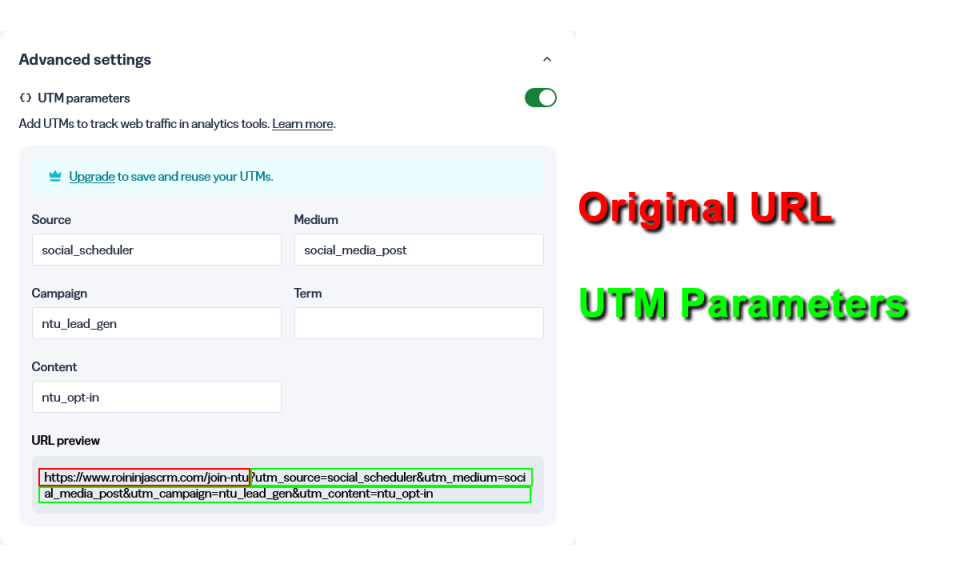
Example:
?utm_source=facebook&utm_medium=social&utm_campaign=crm_compare&utm_content=cta1
#2 Name Source the Same Way Every Time
Examples:
google_ads, meta_ads, email, referral_partner
#3 Eliminate Duplicate Contacts In Your CRM
This makes it so much less confusing for you and your team. Each contact has just one record, one timeline, and one communication stream.
#4 Make Sure Tracking Fires
Google Analytics, pixels, events, conversions. But also eliminate any duplicate tracking. For example, Meta Pixels or Google Tag Manager. If you’re not sure where to start, request a Marketing X-Ray Report, and we’ll give you a punch list.
#5 ROI Ninjas CRM Adds Another Layer For Tracking
Another great benefit of ROI Ninjas CRM is that it integrates with Google Analytics, Meta Pixels, and more. Also, it tracks visitors to your funnel pages, conversions, etc. All at your fingertips in one location.
Marketing Attribution Basics: Wire the Stack
What to connect:
Keep your setup light. Because simple beats perfect every time. You can always add more events and integrations later. Get it working first, then add more.
Three Numbers That Make Decisions Easy
You don’t need a software engineering degree. But you do need a whiteboard or spreadsheet and these three numbers.
1. CAC (Customer Acquisition Cost)
What it is: How much you paid to win one new customer.
How to get it:
- Ad spend + any direct campaign cost for a time period.
- Divide by the number of new customers from that same time period.
Example: Spend $1,200, win 6 customers >> 1200 / 6 = $200 CAC.
2. LTV (Lifetime Value)
What it is: The gross revenue you expect from a customer over a normal relationship.
A simple way to estimate LTV:
- Average order value x average purchases per year x years they stay.
Example: $100 per job x 2 jobs/year x 3 years = $600 LTV.
*If you want to be strict, multiply by gross margin to get a profit-based LTV. But start simple so you have an idea of where you are at.
3. Payback Period
What it is: How long until the profit from a new customer pays back your CAC.
A simple formula:
- CAC / average monthly profit from that customer.
Example: $200 CAC; average profit $100/month = Payback Period of 2 months.
So now you can set some guardrails. For most service-based SMBs:
- LTV:CAC greater than 3 to 1 (spend $1 to get $3 back over time)
- Payback Period of less than 6-9 months (shorter is better; cash flow matters)
Build the Dashboard (One Page, Seven Tiles)
Set up a simple view inside your CRM or a spreadsheet. Review it every Monday.
- Spend (this period, example: this week)
- Leads (new contacts with valid phone/email)
- Sales-Qualified Opportunities (people who showed buying intent)
- New Customers
- CAC
- LTV (use your current estimate)
- Payback Period (in months)
Also, break these tiles down by source: google_ads, meta_ads, email, referral_partner, and organic.
Pick an Attribution Model (Keep It Simple)
Don’t overthink models on day one. Use last-touch (the final source before the conversation) to start. Because it’s easy to explain and act on. When your tracking is clean, add a first-touch view to see which channels are best at starting some conversations. But if you run a longer journey (quotes, consults, then close), build a simple blended tile that shows both.
However, if your follow-up is weak, no model will save you. Fix response speed and consistency first with Follow-Up or Fail, then come back to models with better data.
Being the Fastest Wins More Deals. Get There First With ROI Ninjas CRM: It’s Automation, Attribution, & Acquisition!! >>
Mini Case: Home Services Example
(Real Math, Real Decisions)
For example, say you’re a local contractor.
Last 30 days:
- Google Ads spend: $1,500 = 45 leads = 9 customers
- Meta Ads spend: $800 = 38 leads = 4 customers
- Referral partners: $0 ad spend = 12 leads = 5 customers
CAC:
- Google Ads $1,500 / 9 = $167 CAC
- Meta Ads $800 / 4 = $200 CAC
- Referrals: $0 / 5 = $0 CAC
But don’t forget referral gifts or time.
LTV (your estimate): $900 gross revenue per customer across an entire year.
Payback (profit assumption: $300/month from a new customer)
- Google Ads: $167 CAC / $300 = 0.6 months (about)
- Meta Ads: $200 CAC / $300 = 0.7 months (about)
- Referrals: $0 CAC = Instant
Decision: Keep both ad campaigns running. But scale on Google first, and double down on referrals with a formal program. Then tune your funnel with Turn Clicks Into Customers and Simplified Funnels for SMBs. So then, more leads become booked jobs, and your calendar fills up.
Common Screwups That Skew Your Numbers
Small biz owners and entrepreneurs love finding new and improved ways to complicate things. So keep it simple, keep it consistent, and keep it clear. Here are some of the top foul-ups we see:
- Messy UTMs and helter-skelter naming drift. If “googleads” and “Google_Ads” both exist, your dashboard will confuse the hell out of you and the data. Standardize names, stick to them, and your life will be much easier.
- No margin in LTV. Revenue isn’t profit. So to get profit-based LTV, multiply by your gross margin. Want simple math guardrails to figure it out? Check out our article, 10 Customer Acquisition Basics for more details.
- Vanity metrics. Clicks and views don’t pay the bills. Leads, booked calls, shows, and closes you can take to the bank. Measure pipeline stages, not bragging rights. Track Leads Effectively shows you how.
- Slow response. If you take hours or days to reply, faster competition wins every time. The fix is systems and discipline. However, implementing the guides in Enhancing Customer Experience will tighten the whole journey.
- Starving winners, and feeding losers. Re-allocate budget and efforts weekly. If a source misses your CAC/Payback targets for two weeks straight, cut it or fix it. Don’t sit around wishing it were better.
Marketing Attribution Basics: Weekly Routine
First, pick a day to do this and stick with it every week:
- Open your seven-tile dashboard.
- Review totals and by source tiles.
- Compare to targets: LTV:CAC greater than or equal to at least 3:1; Payback less than 6-9 months.
- Scale winners by 10-20% budget increase.
- Fix or pause losers (creative, offer, audience, or page).
- Check follow-up SLAs (speed, number of touches, channel mix). If reps (or you) lag, tighten the workflow.
- Ship one small improvement this week (headline, offer, page speed, nurture sequence, or booking flow).
One of the biggest takeaways from Marketing Attribution Basics should be to stay consistent. Also, this is simple maintenance to keep you closing deals and your company growing. So once you get into the habit, this should only take about 30 minutes.
Next Steps: Make It Operational
- Lock in the stack. GA4 + ROI Ninjas CRM + ad platforms + online calendars. Keep it light and reliable. Complex kills. Perfection kills.
- Harden the funnel. Clean page copy, one clear offer, fast page load speed, easy booking. Then expand with Sales Funnels That Work.
- Own the map. Local buyers search with intent. Use your attribution work to connect local demand with Dominate Local Search.
- Own their phones. Millennials and Gen Y almost always have their face buried in a phone. Make your offers more appealing with SMS Marketing.
- Protect your budget. If times are tight, use some of the power plays from Budget-Friendly Guerrilla Marketing to keep your pipeline filled.
- Run your numbers weekly. When your CAC rises or Payback stretches out, fix it. Look at your inputs like creative, targeting, offer, and follow-up. There are only a handful of reasons why a campaign fails.
Marketing Attribution Basics Wrap Up
Marketing Attribution Basics isn’t about flashy dashboards or vanity metrics. But it is about making faster, safer decisions with simple math you can trust. Then you scale what works and stop what doesn’t. Because that’s how small businesses buy back time, protect cash flow, and grow with consistency.
Cut Guesswork. Scale What Makes You Money.
If your CAC climbs or payback drags out longer, the fix is in your systems. We’ll map it, clean it, and tune it fast.